Mordor Intelligence has published a new report on leadless pacemaker market, offering a comprehensive analysis of trends, growth drivers, and future projections.
Introduction:
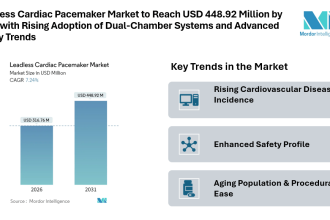
The leadless pacemaker market is expected to grow from USD 295.37 million in 2025 to USD 316.76 million in 2026 and is forecast to reach USD 448.92 million by 2031 at 7.24% CAGR over 2026-2031. The market growth is driven by the shift from single-chamber ventricular pacing to dual-chamber and conduction-system solutions, offering physiological synchrony without transvenous leads. North America currently dominates the market, while Asia-Pacific is witnessing the fastest expansion. Increasing prevalence of bradyarrhythmias, aging populations, and MRI-conditional approvals are strengthening market adoption, creating a strong foundation for long-term growth.
Key Trends in the Leadless Cardiac Pacemaker Market
- Rising Cardiovascular Disease Incidence – Increasing cases of bradyarrhythmias and cardiovascular disorders drive demand, with over 600,000 new pacing candidates annually benefiting from minimally invasive leadless pacemakers.
- Enhanced Safety Profile – Leadless pacemakers eliminate leads and pockets, reducing major complications and infection risks, particularly for dialysis patients and those with weakened immunity.
- MRI-Conditional Approvals – Devices approved for MRI expand patient eligibility, enabling use in individuals requiring frequent imaging for oncology, neurology, and other conditions.
- Aging Population & Procedural Ease – Most recipients are over 75; percutaneous implantation without general anesthesia and long battery life (≈7 years) support adoption in both developed and emerging markets.
Check out more details and stay updated with the latest industry trends, including the Japanese version for localized insights:
Leadless Cardiac Pacemaker Market Segmentation
The leadless cardiac pacemaker market can be segmented by product type, indication, end-user, and geography. Key insights include:
By Product Type (Value, USD million)
- Single-Chamber Ventricular Leadless Pacemaker
- Dual-Chamber Leadless Pacemaker
By Indication (Value, USD million)
- Bradyarrhythmia
- Atrioventricular Block
- Atrial Fibrillation
- Others
By End User (Value, USD million)
- Hospitals
- Cardiac Centres
- Ambulatory Surgical Centres
By Geography
- North America
- South Amerca
- Middle east&Africa
- Europe
- Asia pacific
This segmentation allows stakeholders to understand market dynamics in specific patient populations, technology adoption, and regional opportunities.
Key Players in the Leadless Cardiac Pacemaker Market
The competitive landscape of the leadless cardiac pacemaker market is concentrated, with major players including Medtronic, Abbott, and Boston Scientific. These companies defend market positions through clinical trial evidence, product differentiation, and expanding device approvals, including MRI-conditional labeling. Boston Scientific has introduced modular platforms that may challenge established designs, while Abbott and Medtronic continue to expand dual-chamber and conduction-system offerings. Emerging players are gradually entering the Asia-Pacific market, benefiting from streamlined regulatory approvals and increasing hospital investments. High competition drives continuous improvements in safety, implantation ease, and device functionality.
- Abbott Laboratories
- Medtronic PLC
- EBR Systems Inc.
- Boston Scientific Corporation
- MicroPort Scientific Corporation
Conclusion:
The leadless cardiac pacemaker market is poised for consistent growth, supported by demographic trends, clinical adoption, and product innovations. Hospitals and cardiac centers remain primary end users, while increasing awareness of minimally invasive alternatives continues to expand the eligible patient base. North America will maintain a leadership position, while Asia-Pacific is expected to emerge as a key growth region due to hospital investments and favorable regulatory environments. Market participants can capitalize on rising dual-chamber adoption, MRI-conditional approvals, and the growing prevalence of bradyarrhythmias to strengthen their presence.
Industry related Reports:
Cardiac Arrhythmia Monitoring Devices Market : The Cardiac Arrhythmia Monitoring Devices Market report segments the industry into By Devices (Event Monitoring Devices, Continuous Rhythm Monitoring Devices, Holter Monitoring Devices, Other Devices), By Service Providers (Mobile Cardiac Telemetry Monitoring Service Providers, Independent Diagnostic Testing Facilities/Clinics), and By Geography (North America, Europe, Asia-Pacific, Middle-East and Africa, South America).
Global Artificial Heart Market : The Artificial Heart Market Report is Segmented by Type (Ventricular Assist Device, Total Artificial Heart, Heart-Lung Machine, and Other Types), Power Source (Internal Battery and External Battery), End User (Hospitals and Clinics and Specialty Clinics), and Geography (North America, Europe, Asia-Pacific, Middle East and Africa, and South America).
Ambulatory Cardiac Monitoring Market : The Ambulatory Cardiac Monitoring Market is Segmented by Device Type (ECG Monitors, Implantable Cardiac Loop Recorders, and More) Service Provider (Independent Diagnostic Testing Facilities (IDTFs), and More), Indication (Atrial Fibrillation, and More), Connectivity (Wired and Wireless Devices), End-User (Hospitals and More), and Geography (North America, Europe, and More).
About Mordor Intelligence:
Mordor Intelligence is a trusted partner for businesses seeking comprehensive and actionable market intelligence. Our global reach, expert team, and tailored solutions empower organizations and individuals to make informed decisions, navigate complex markets, and achieve their strategic goals.
With a team of over 550 domain experts and on-ground specialists spanning 150+ countries, Mordor Intelligence possesses a unique understanding of the global business landscape. This expertise translates into comprehensive syndicated and custom research reports covering a wide spectrum of industries, including aerospace & defense, agriculture, animal nutrition and wellness, automation, automotive, chemicals & materials, consumer goods & services, electronics, energy & power, financial services, food & beverages, healthcare, hospitality & tourism, information & communications technology, investment opportunities, and logistics.
For any inquiries or to access the full report, please contact:
media@mordorintelligence.com
https://www.mordorintelligence.com/